
Names have been changed to protect the children’s privacy.
Everyone at the centre has been warm with me since I came back. Part of it is that I am no longer a student but a volunteer now, and part of it is that they remember the work I did last time.
The beginners class
Before returning to my old class, I wanted a little more exposure to the different classes, so I was first sent to a beginners class, a kind of early intervention group. Two volunteers were already there. The teacher asked me to sit with a girl named Sana, who had recently joined and was crying because another child was being loud and it had overwhelmed her. There were about five children and three adults in the room, and it was a little noisy and chaotic. I was told the noise was what had upset her, and that she has slight paralysis in her left arm.
As I sat with her she slowly calmed down. My job was just to make her feel comfortable, and I think I managed that. She even smiled at me, which made me very happy, because I did not want her to feel bad about coming to school. I have noticed that small things like high fives and saying good job really work with these children.
She had a toy where she placed bead shaped pieces onto four pillars. She put them on and took them off carefully, and handed them to me whenever I asked. I used this to build her muscle memory a little and to see whether she could follow simple picking and dropping instructions. The only thing she struggled with was finding the hole in each bead while putting it on.
After about fifteen minutes I was asked to move to another class that needed more help, and that is the class I have been in since.
The class I joined
These children are more advanced. They can say basic things, do simple writing, count, and recite the days of the week and the months of the year. Their work includes tracing and writing spellings, vocabulary, numbers, the alphabet, and a lot of playtime. They are all at different levels, so their syllabuses are individual, though I did not follow up much on the specifics. Each child has a set of things they do every morning, one works on numbers, another matches numbers to spellings, another puts the days of the week in order, and so on.
I am the only volunteer in that class right now, and I have worked one on one with the children a fair amount. Along with the books, there are other materials they use, a pop it, a digital writing board, something called lacing which is a board with holes and a string they thread through, a set of buttons for practicing buttoning up, and a large abacus. They have loads of toys, blocks and puzzles too.
The children
My first task was to go over the alphabet with two boys using a picture book. The first, Ishaan, was very patient and waited his turn. He could recognize the pictures easily, and though his pronunciation was a little off, it was mostly understandable, words with the letter u came out much clearer than the rest. He has Down syndrome. He might be my favorite, because he is not chaotic at all, just calm and sweet. When I arrived one morning the children were lined up outside the washroom, and Ishaan wanted to hold my hand on the way back to class. I also helped him type the alphabet on Microsoft Word, where he only had to fill in the last few letters. He managed it, though he deleted part of it by accident once and I had him redo it rather than fixing it myself. Before that he had been playing quietly with a pop it. There is an older boy, whose name I have forgotten, who comes into our class whenever he passes by just to give Ishaan a kiss on the head. It has happened twice on different days in front of me, and I love how openly these children show affection for each other.
Ishaan was absent one day, and it felt a little empty without him. He is usually such a calm presence that I still noticed he was gone, and I was quite bummed about it. I wondered if he was sick. I still do not know why he was away.
Yusuf, the other boy from the alphabet book, was fidgety and needed time to answer, even though he knew everything and had perfect pronunciation. His only real problem was sitting still and staying focused. He would slip out from under the table without my noticing, pull the book from me to turn to a different page, and when I pointed to a hard word he would drag my finger onto an easier one he already knew, which I found very cute. When he did not know a word he would whisper it, and I would help him say it properly, but I had to wait until he was ready to try, because no amount of asking would get him to say it before then. Away from the book he plays happily on his own. One day he set up a little tea party with his toys (cover image), gathering them all together, and it was so sweet that I had to take a picture of it.
Daniel is adorable and more than a little mischievous. He is drawn to anything creative. While I was making origami boats for Independence Day he wanted to be part of everything I was doing, painting included. He would sit beside me or on my lap and help with whatever was in front of me. He creased the paper where I told him to, but during the painting he was harder to manage, because he wanted to keep going well past his turn, and the water cup kept falling over. One of his habits is saying sharing is caring whenever he does not want to finish something in his tiffin, usually to get me to eat his apple or biscuits instead. At one point he tried, quite seriously, to put a biscuit in my mouth. He is very good with puzzles, blocks, and Legos, and loves them. One day I was playing Legos with him, and when I got up to do something else, he came over after a while, took me by the hand, and dragged me back to the table, where I was trying to build a truck from the manual and was fairly sure I would end up short a few pieces. He also loves having his photo taken, and poses for it, saying cheese and grinning with all his teeth. When we go to the hall at the end of the day to wait for the children to be collected, he likes me to chase him, and if I sit down he takes my hand and pulls me up to play again. Before lunch he tucks his hand towel into his shirt like a character out of Tom and Jerry, which I think he picked up from a teacher or his parents rather than a cartoon.
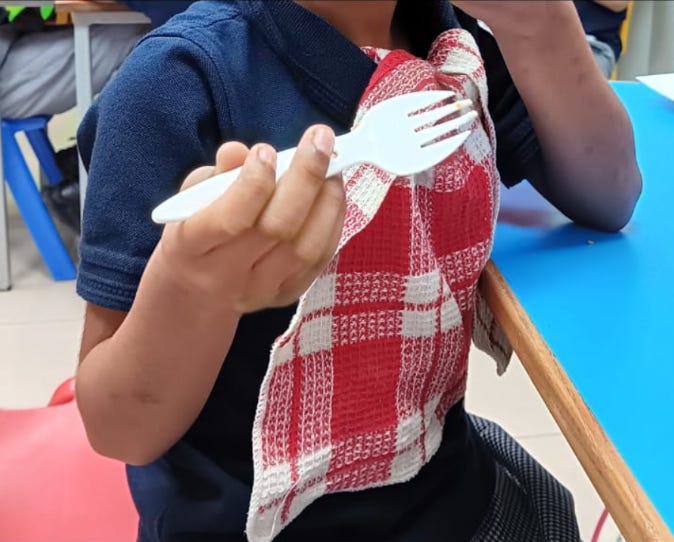
Kabir is the child I have noticed the most. He is not fluent with words, but his understanding is remarkable, and he gets his point across by pointing and through actions. Once it was time for his speech therapy session and none of us had realized, so he pointed to the chart on the board with all the therapy timings until we understood. He is socially very sharp and has taken on a kind of parental role with the others. He has taken it on himself to hang everyone’s bag on the hooks, always asking us first, and to get his friends water. He can tell when someone is happy or sad, and if a child is crying he is the first to hug them. One day he hugged a child in the hall who I do not think he even knew. He and Daniel are close, and he has waved and said hi to me more times than I can count. I once watched him help Daniel drink his water like a little teacher, and when Daniel climbed onto my lap, Kabir pushed him off, which was very funny given how protective he is. For all his social sense, though, academic work is where he struggles the most. Even the numbers 1, 2, 3 are hard for him. One day I was asked to help him identify them and put them in order. He would get it one second and forget it the next, so we went over it again and again, and the repetition seemed to help him hold onto it a little. I have also watched him work on a board of buttons, practicing doing them up. I hope he can get there confidently while I am here.
Vivu spends part of his time reciting lines from Peppa Pig and other rhymes that he has picked up from the show. When he does not want to do his work, the teacher tells him she will give his tiffin to another teacher, which scares him, and he says I’ll do it straight away. Then he reassures himself under his breath, something like don’t worry Vivu. He gets frustrated fairly easily, so he needs someone sitting with him to keep him going.
Omar cannot sit still to save his life, and he follows me everywhere. He wants to grab everything within reach and put it in his mouth. He trailed me around the classroom as I moved between tables, clearly interested in what I was doing, and got hold of the boats, the flags, a ruler, and even the scissors and glue, which are the last things you want him near. I got a little annoyed at him for not staying in his seat, though it would only have been nicer if he had not kept taking things and running off with them.
There was a birthday at the centre once, and a teacher came in to hand out cake. Yusuf wanted some, so he pretended to cry and miss his dad so we would coax him with it. He is a clever one, and I gave him a bite, since I could hardly keep it all to myself.
The Independence Day board
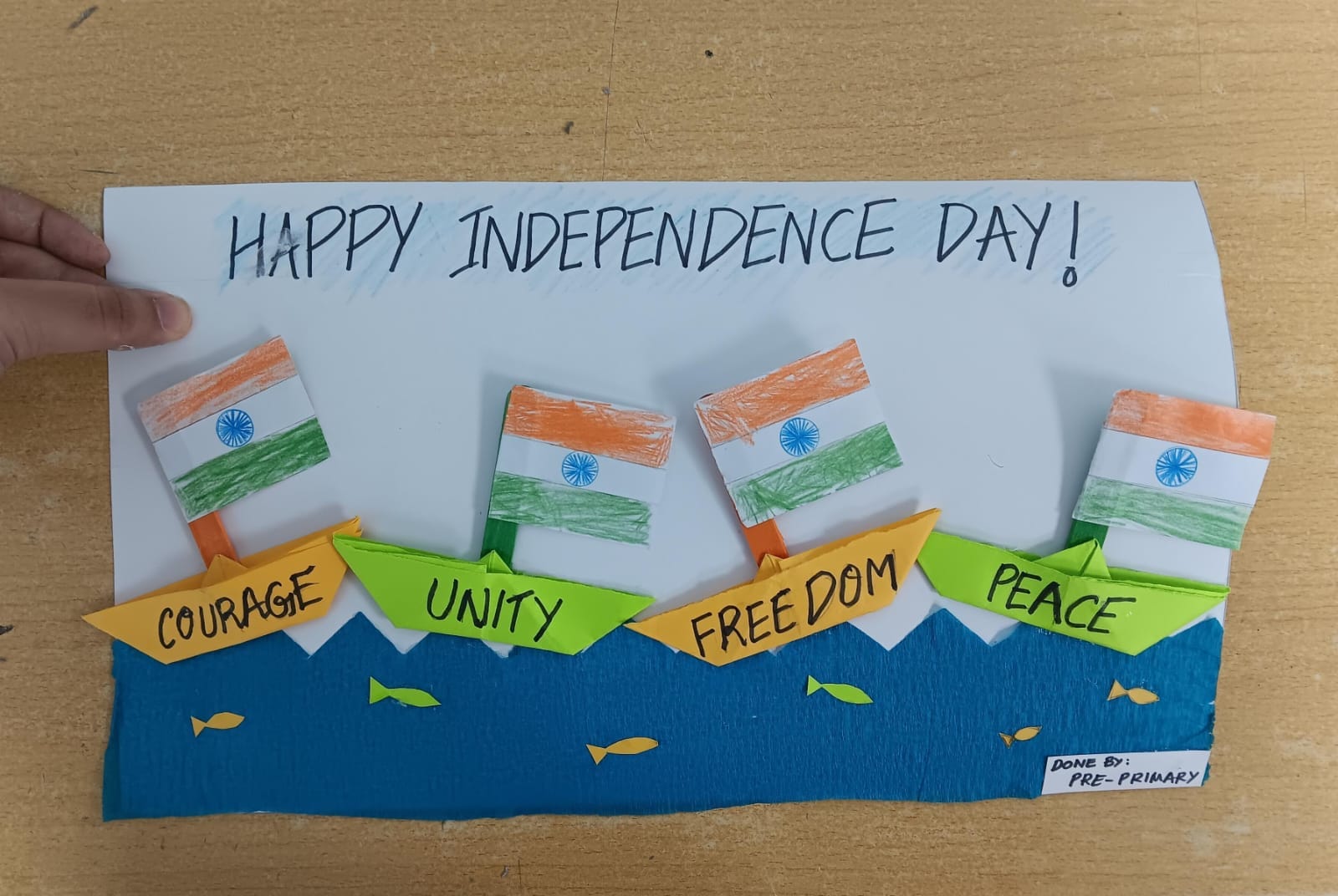
The children had an Independence Day assembly on Thursday, and each class had to make something for the soft board on an A4 sheet. I was put in charge of the idea for our class. We first tried a thumbprint tree, dabbing prints in the colors of the flag onto a drawn trunk, but it came out too childish for the level of these children. So I looked online for ideas. I had been leaning toward origami from the start, so I decided we would make tiny origami boats, each carrying an Independence Day value, courage, unity, freedom, and peace, with a small flag attached. The children helped fold the paper as I instructed, creased it, and colored in the flags. It looks like a simple task, but it actually took me quite a while. Some of them took the paper and started folding on their own while others listened and pressed the creases properly, so a few came out slanted from being pulled around while pressed. I do not blame them at all, since I had made the paper quite small. I made a lot of boats, but only four fit on the sheet in the end, and it replaced the tree, which we kept as a backup.
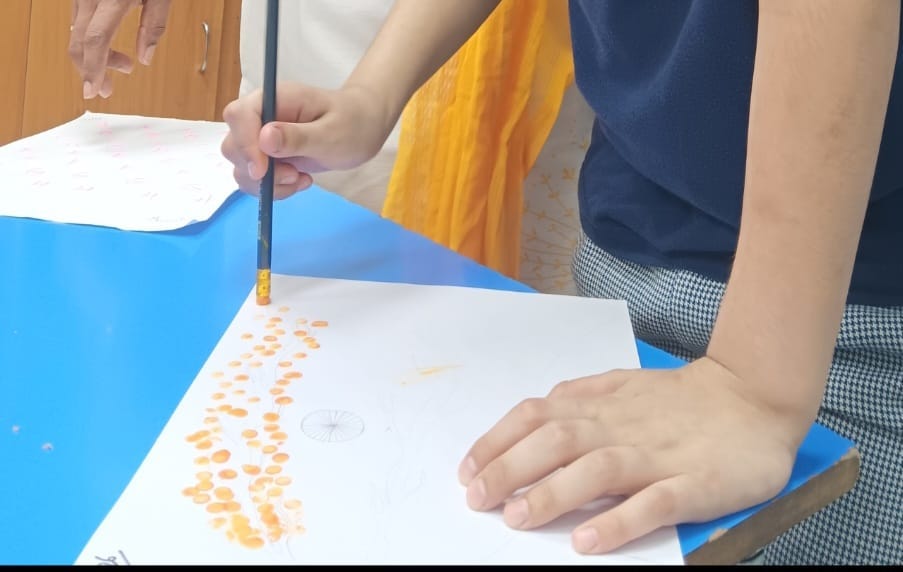
Every child also had their own tree to do in their book, a different kind from the one on the board, dotted in with the back of a pencil rubber pressed into paint to build up the leaves.
While I was finishing everything off, the children were playing with a toy kitchen set, with cups, trays, and plastic food. They kept bringing me pretend tea and water balanced on their trays, tapping me on the shoulder and announcing teacher, chai. It was so endearing that I could not be annoyed at being served for the hundredth time, mostly by Ishaan and Kabir. The funny part was that I kept being brought tea and water, and no one ever offered me the main course.
The small things
Children this age do a lot of small, messy things. Some of them are committed nose pickers, and I am fairly sure everything in the classroom has been in someone’s mouth at some point. In the other class I used to be in, this really put me off, and I found it hard to get my appetite back. Now it does not bother me at all. I suppose I have just got used to it. The same goes for the smell of their lunchboxes mixing together at lunchtime, which I no longer notice.
One day I took Daniel to wash his hands after he had eaten. I was a little afraid to go into the washroom, because the floor was completely wet and I could not tell whether it was water or something else. I have some sensory issues with things like that, but I went in with him anyway and tried not to let it show on my face, since he had already started opening the soap bottle and filling it with water while I hesitated. So I got the situation under control, stopped being squeamish, and went in properly. I shivered as the discomfort built up, but everything turned out fine.
What I have taken from it
I have noticed that I get a little frustrated when a child clearly knows what to do and still cannot manage it in the moment. It is not their fault at all. You just end up rooting so hard for them that you forget, for a second, that they need patience and are not struggling on purpose to annoy you. It is something I have had to catch in myself.
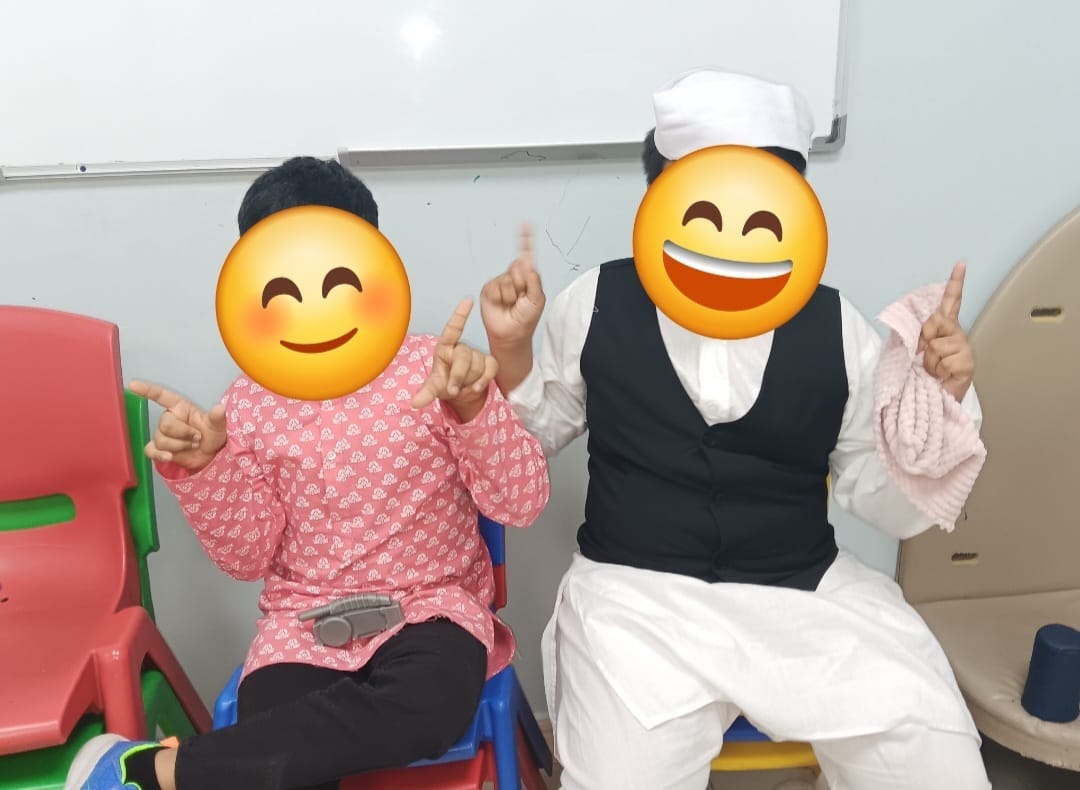
Everyone at the centre has been kind to me. There are two interns who have finished their undergraduate degrees and work there, and I had a good chat with them about my own plans. On the day of the assembly the children came dressed up and looked adorable, Kabir in a Gandhi cap and three of the others in kurtas, looking very smart. I have a group photo with all of them, which they were all keen to be in.
I come home tired on the days I go. The work takes more out of me than I expect, and by the time I am back I do not have much left. But it has been good for me. It has given my days some structure, which I needed, because on a gap year it is easy to let time slip and end up at home doing very little. Going in at a set time, to children who are happy to see me, is what keeps me on some kind of routine.
Wow, reading this, my day is made already :)
Thanks for sharing this!!!